



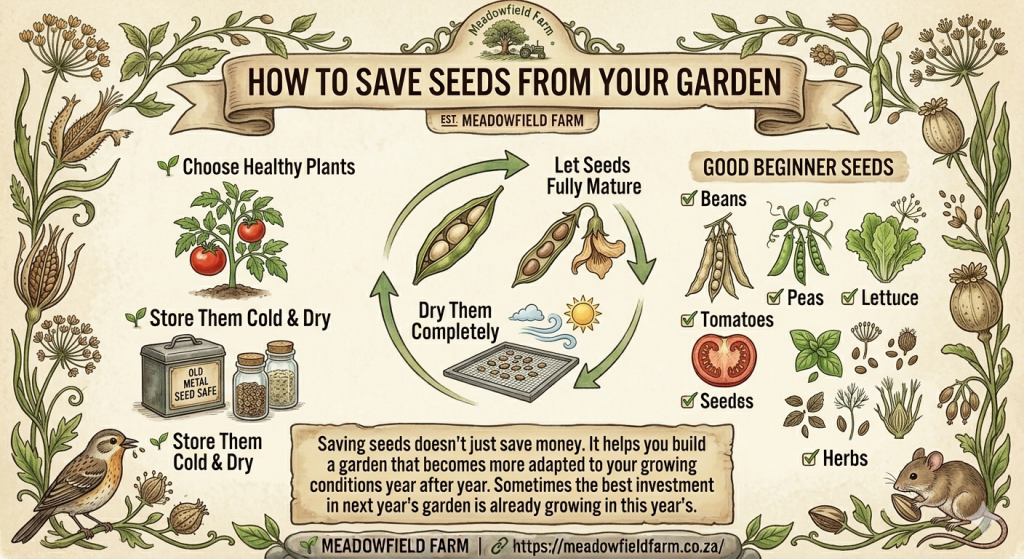
How to Save Seeds From Your Garden
Saving seeds is one of the oldest gardening skills in the world.
For thousands of years, gardeners and farmers selected seeds from their best plants and used them to grow future crops.
Today, many gardeners buy new seeds every season, but learning to save your own seeds can reduce costs, increase self-sufficiency, and help preserve plant varieties you enjoy growing.
The good news is that seed saving is often much simpler than people think.
Why Save Seeds?
There are several benefits to saving your own seeds.
Save Money
One packet of seeds can produce dozens or even hundreds of future plants.
Instead of purchasing the same varieties each season, you can collect and store your own.
Build Self-Sufficiency
The more resources your garden can provide for itself, the less dependent you become on outside inputs.
Seed saving is one of the easiest ways to take another step toward a more sustainable garden.
Preserve Plants You Love
Perhaps you’ve grown a tomato with incredible flavour or lettuce that thrives in your climate.
Saving seeds allows you to continue growing varieties that perform well in your garden.
Adapt Plants to Local Conditions
Over time, plants grown and selected in the same environment may become better suited to local conditions.
This is one of nature’s most powerful tools.
Start With Easy Crops
Some plants are much easier to save seeds from than others.
Beginners should start with:
Beans
Allow pods to dry completely on the plant.
Once dry, remove the beans and store them for next season.
Peas
Like beans, peas are among the easiest seeds to collect.
Simply allow pods to mature and dry before harvesting.
Lettuce
If left unharvested, lettuce eventually produces flowers and seeds.
Once the seed heads become dry and fluffy, seeds can be collected and stored.
Herbs
Many herbs such as basil, coriander, dill, and parsley produce abundant seeds that are easy to harvest.
Tomatoes
Tomatoes require an extra step because the seeds are surrounded by a gel coating.
However, they are still popular among seed savers and well worth learning.
Choose Healthy Plants
Not every plant should contribute seeds.
Select plants that are:
✔ Healthy
✔ Productive
✔ Disease resistant
✔ Well adapted to your conditions
These are the qualities you want to encourage in future generations.
Let Seeds Fully Mature
This is one of the most common mistakes beginners make.
Many vegetables are harvested before their seeds are ready.
For seed saving, patience is essential.
Allow seeds to remain on the plant until they are fully mature whenever possible.
Nature knows when a seed is ready.
Dry Seeds Thoroughly
Before storage, seeds must be completely dry.
Even small amounts of moisture can lead to:
- Mold
- Rot
- Poor germination
Spread seeds out in a dry, shaded area with good airflow.
Allow them to dry naturally before storing.
Store Seeds Correctly
Seeds last longest when stored in:
- Cool conditions
- Dry conditions
- Dark conditions
Good storage options include:
- Paper envelopes
- Glass jars
- Recycled containers with tight-fitting lids
Always label seeds with:
- Plant variety
- Date collected
Future you will be grateful.
A Few Things to Know
Not every plant will produce seeds that grow exactly like the parent plant.
Hybrid varieties may not produce identical offspring.
For beginners, this isn’t a reason to avoid seed saving.
It’s simply something to learn about as your gardening skills grow.
The important thing is to start practicing the process.
Start Small
You don’t need to save seeds from every plant.
Choose one or two easy crops and experiment.
Beans, peas, and herbs are excellent places to begin.
As your confidence grows, you can expand your seed-saving skills year after year.
Final Thoughts
Seed saving is more than a way to save money.
It’s a way to participate in one of gardening’s oldest traditions.
Each seed carries the potential for future harvests, future learning, and greater self-sufficiency.
The next time you’re harvesting vegetables, remember that some of next season’s garden may already be growing right in front of you.